

Artificial intelligence is no longer confined to innovation labs or IT departments. It is influencing capital allocation, pricing models, supply chain resilience, customer engagement, and long-term strategy. According to research by Microsoft and LinkedIn, more than 75% of knowledge workers surveyed use AI (Source: 2024 Work Trend Index Annual Report).
Yet as AI systems become embedded in enterprise workflows, a critical question is emerging: are managers equipped to lead in an AI-driven environment?
Across industries, organisations are deploying machine learning models and Generative AI applications at increasing speed. But while technology adoption is accelerating, managerial readiness often lags. Many decision-makers are fluent in dashboards and analytics summaries, yet less familiar with how models are built, where they fail, and how they should be governed.
This is not a technical gap. It is a leadership gap.
Increasingly, boards and CXOs expect managers to evaluate AI investments, question algorithmic outputs, assess ethical risks, and align AI initiatives with measurable business outcomes. AI literacy has shifted from being optional to being integral to managerial authority.
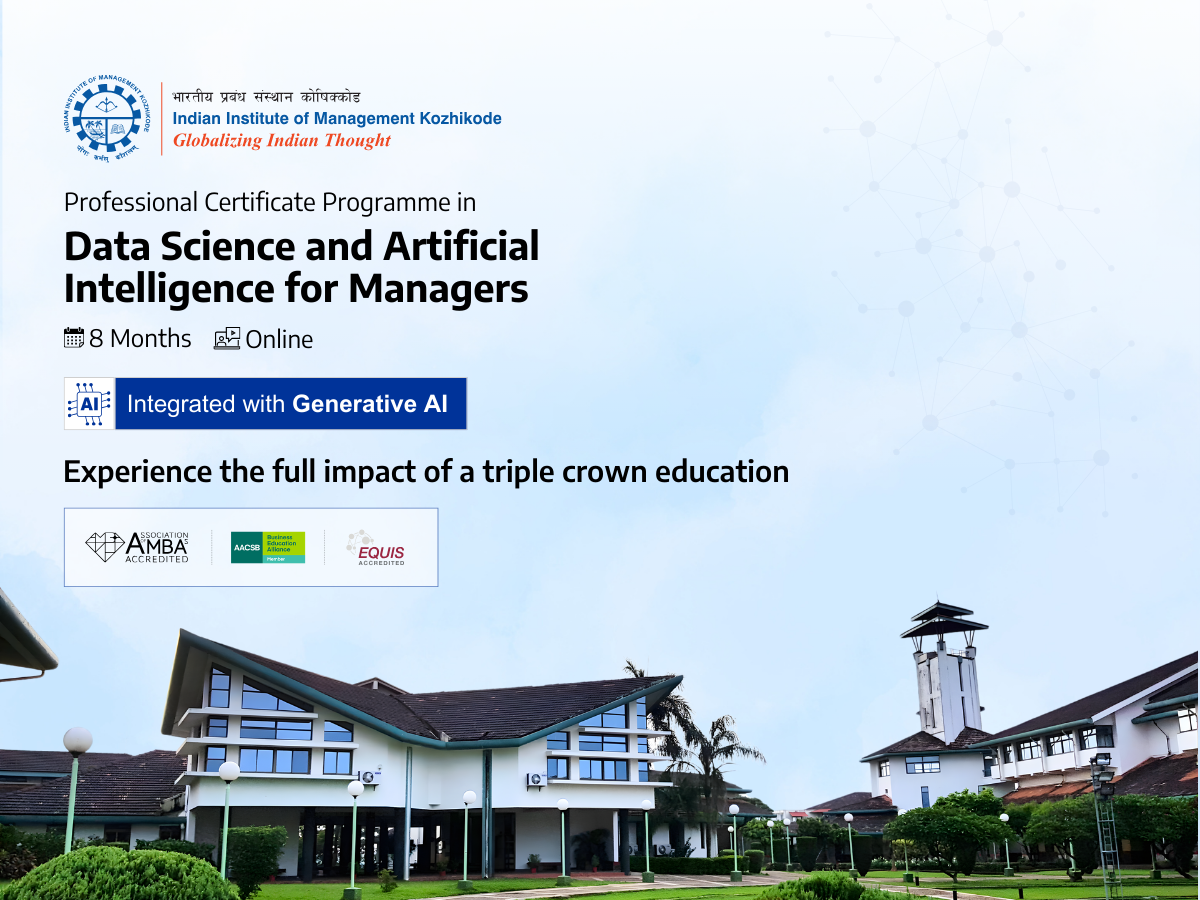
It is within this evolving landscape that IIM Kozhikode’s Professional Certificate Programme in Data Science and Artificial Intelligence for Managers has gained significance.
From Data Awareness to Strategic AI Leadership
For years, managers were encouraged to become “data-driven.” Today, that mandate has expanded. Leaders must now understand not just data, but the intelligence systems interpreting it.
Managerial AI fluency includes the ability to:
- Distinguish between supervised and unsupervised learning applications
- Interpret regression, classification, and time-series models in forecasting contexts
- Evaluate the relevance of neural networks and deep learning for business problems
- Assess the strategic implications of Natural Language Processing and recommender systems
- Integrate Generative AI responsibly across functions
- Build governance mechanisms that mitigate bias and risk
The Professional Certificate Programme in Data Science and Artificial Intelligence for Managers at IIM Kozhikode is structured around this transition — from operational familiarity to strategic clarity.
Delivered over 32 weeks in a flexible online format, the programme is designed for mid- to senior-level managers who must continue leading teams while upgrading their AI capability. With a weekly commitment of 5–6 hours, participants engage with structured modules, assignments, and industry expert-led sessions without interrupting their careers.
The objective is not to produce technologists. It is to empower decision-makers.
A Learning Architecture Designed for Authority, Not Abstraction
The programme follows a deliberate progression.
Participants begin with foundational concepts in data cleaning, modelling, and visualisation — essential for understanding the integrity of inputs that drive business decisions. The curriculum then advances into supervised and unsupervised learning, regression and classification techniques, time-series analysis, and neural networks.
From there, the focus shifts toward more strategic terrain:
- Reinforcement learning and advanced machine learning applications
- Natural Language Processing and recommender systems
- Generative AI models and cross-functional business use cases
- Responsible AI and ethical considerations
- Integration of AI into existing systems
- AI-led governance, compliance, and culture
- Development of a comprehensive AI Strategy
The programme culminates in industry-backed capstone projects, including a final capstone on AI Strategy. This ensures that participants do not simply understand AI frameworks — they learn to align them with organisational priorities, budgets, and performance metrics.
For managerial authorities, this distinction is critical. Knowing what AI can do is different from deciding what it should do.
Closing the Leadership Gap in India’s AI Expansion
India’s AI ecosystem is expanding rapidly, but leadership capability remains uneven. Organisations increasingly require managers who can bridge conversations between technical teams and executive leadership.
This means being able to:
- Translate model outputs into actionable business insight
- Challenge unrealistic expectations around automation
- Evaluate ROI and operational feasibility
- Drive cross-functional AI adoption
- Embed governance standards that protect organisational reputation
The Professional Certificate Programme in Data Science and Artificial Intelligence for Managers addresses this requirement directly by positioning AI as a boardroom-level competency.
Designed specifically for managers, consultants, and entrepreneurs, the programme recognises that AI transformation is not a siloed technical initiative — it is an organisational mandate that requires informed authority at multiple levels of leadership.
Generative AI as a Strategic Lever
While Generative AI often captures headlines for its novelty, its long-term value lies in strategic integration. The programme at IIM Kozhikode examines Generative AI applications across marketing, product management, finance, and supply chain management — not as isolated tools, but as business enablers.
Equally important, participants examine the governance, compliance, and cultural implications of AI adoption. As regulatory scrutiny increases and stakeholder expectations evolve, responsible AI leadership is becoming a core managerial responsibility.
In this context, AI competence is not about experimentation. It is about stewardship.
The Future of Managerial Education
As AI reshapes competitive landscapes, managerial education is also undergoing recalibration. The demand is shifting from conceptual exposure to structured capability-building that connects technical intelligence with strategic execution.
IIM Kozhikode’s Professional Certificate Programme in Data Science and Artificial Intelligence for Managers reflects this shift. By combining academic depth, applied learning, and a leadership-centric curriculum, it prepares managers not merely to understand AI trends, but to lead AI-driven transformation responsibly.
In an economy where algorithms increasingly inform decisions, the authority of a manager will depend not just on experience, but on informed technological judgement.
The question is no longer whether AI will influence managerial decisions. It already does.
The question is whether managers will be prepared to influence AI in return.
